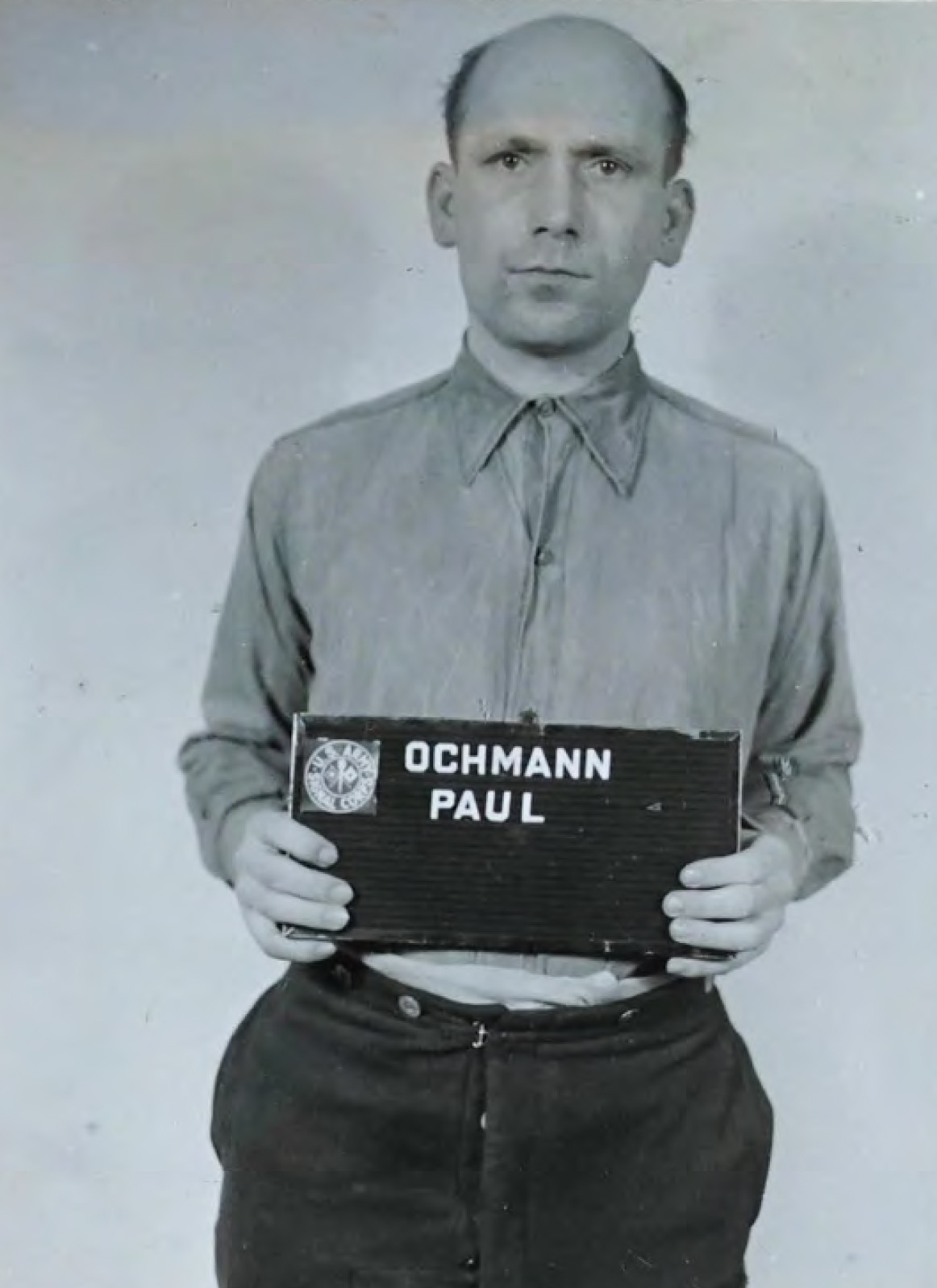
SS non-commissioned officer convicted of the murder of eight American prisoners of war at Ligneuville, Belgium, on 17 December 1944. Sentenced to death; commuted to life imprisonment by General Lucius D. Clay.
The Ligneuville Executions, 17 December 1944
Following the capture of Ligneuville by Kampfgruppe Peiper on the afternoon of 17 December, twenty-two Americans from the 27th Armored Infantry Battalion were taken prisoner. Ochmann separated eight of them and ordered them to dig graves for three Germans killed in the fighting. When the task was completed, Ochmann and a private soldier (identified as Sturmmann Seuss) shot each man in the back of the neck. A ninth man, Pfc. Joseph P. Mass, survived: the bullet passed through the side of his neck as he jerked in fear. (MacDonald, A Time for Trumpets, 1984; Castor, La route des massacres, 2005)
Peiper was inside the Hôtel du Moulin when the executions took place. The remaining fourteen prisoners owed their survival to the intervention of the Rupp family, owners of the hotel. (Castor, 2005)
The killings followed the pattern established earlier that day at the Baugnez crossroads, where approximately 84 American prisoners had been murdered by other elements of Kampfgruppe Peiper.
Witness Marie Lochem observed Ochmann select the eight prisoners for grave-digging. Eyewitness Maria Lochen watched the shootings from 25–30 yards away. Walter Fransee (1. Panzergrenadier-Division) testified at trial that Ochmann came to his vehicle to ask for help shooting 8 POWs. However, Fransee recanted his statement in June 1948, claiming it was obtained under duress.
Pergrin and Hammel give seven killed and one left for dead. MacDonald and Castor give eight killed. Mass’s own sworn statement (20 May 1945) describes nine men lined up, with himself the sole survivor — explaining why only eight bodies were recovered. Mass never testified at the Malmedy trials; his statement was never entered into evidence.
Trial and Sentence
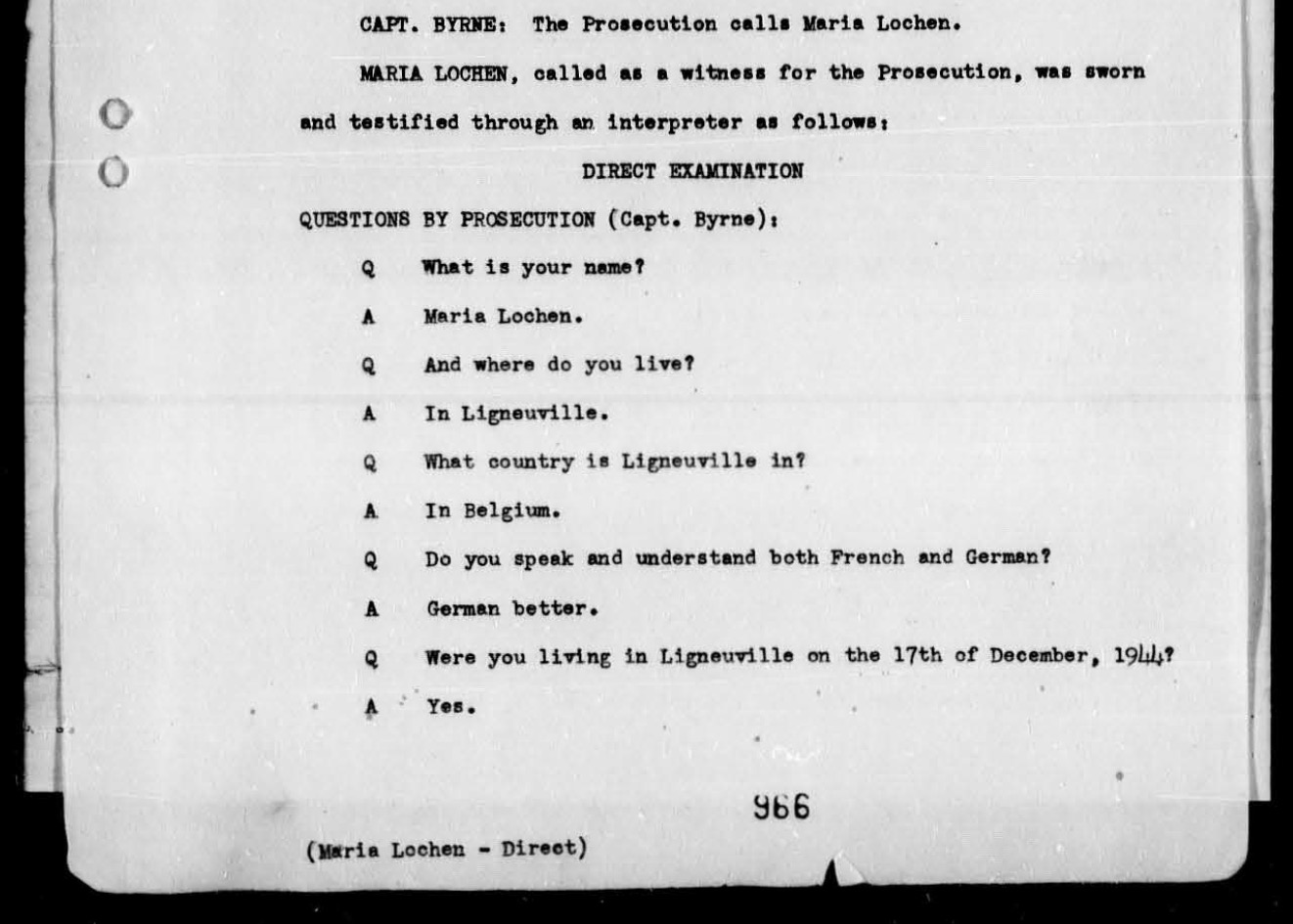
Ochmann was tried as part of the broader Malmedy massacre proceedings. His conviction rested primarily on two pieces of evidence: his own sworn extrajudicial confession, and the corroborating testimony of Walter Fransee.
General Lucius D. Clay, review of 25 March 1949:
“In a sworn extrajudicial statement, Ochmann admits to having shot four or five unarmed American prisoners of war in the neck with a pistol while a private soldier assigned to assist him shot the remainder. Lieutenant Perl, who interrogated Ochmann, testified at the trial that this statement was made voluntarily and that no threats or promises were used to procure the statement.”
“I am convinced of the guilt of Ochmann of the cold-blooded murder of unarmed American prisoners of war without cause. However… I am unwilling to impose [the death sentence] only because of the lack of sufficient corroborating evidence other than that which might have been obtained through improper methods. Therefore, having no doubt as to the guilt of the accused, I am commuting the death sentence to life imprisonment.”
(U.S. Senate, Malmedy Massacre Investigation, Pt. 2, GPO 1949, pp. 360–380)
Ochmann filed a sworn statement on 11 February 1948 in which he repudiated his confession, claiming he had been “badly beaten and threatened during his interrogation and… imprisoned in a room without heat on short rations” until he would “have written anything desired.” Fransee similarly recanted on 2 June 1948. The Simpson report and the Administration of Justice Review Board both found evidence of general maltreatment of prisoners during interrogation, though neither could establish specific instances for individual defendants.
The subsequent EUCOM investigation classified Ochmann in Group 2: “Prisoners alleging physical maltreatment and not showing evidence to support the contention.” By contrast, several of his Kampfgruppe comrades — including Diefenthal, Preuß, and Siptrott — were placed in Group 3, having presented physical evidence of maltreatment. (U.S. Senate, Malmedy Massacre Investigation, Pt. 2, GPO 1949, pp. 381–401)
Timeline
Executes eight American prisoners of war at Ligneuville, Belgium. A ninth man, Pfc. Mass, survives.
Tried as part of the Malmedy massacre proceedings at Dachau. Convicted and sentenced to death.
Files sworn statement repudiating his confession, claiming coercion during interrogation.
General Clay commutes death sentence to life imprisonment.
Sources
- MacDonald, Charles B. A Time for Trumpets: The Untold Story of the Battle of the Bulge. Morrow, 1984.
- Castor, Henri. La route des massacres. Le GI face à la 6e Armée Panzer, t. 1. De Krijger, 2005.
- Pergrin, David E., and Eric M. Hammel. First across the Rhine: The 291st Engineer Combat Battalion in France, Belgium, and Germany. New York: Ivy Books, 1990.
- U.S. Senate. Malmedy Massacre Investigation, Pt. 2. Government Printing Office, 1949.
- EUCOM Release No. 154 / No. 162, 25 March 1949. Text of General Clay’s report to the Department of the Army.