The Battle of the Bulge — Notebook Chapters Order of Battle People Places Units Timeline Bibliography Vestiges EN/FR
Place Chronology

Ligneuville

German: Engelsdorf; Wallon: Lègnoûvèye — Commune of Malmedy, Liège province, Belgium
Coordinates: 50°22′31″N, 6°03′16″E Commune: Malmedy Sector: Kampfgruppe Peiper Road: N62 (Malmedy–Saint-Vith) Key dates: 17–18 December 1944 Allied units: 49th AAA Brig. HQ, CCB/9th Armd service elements German units: Kampfgruppe Peiper (1. SS-Pz.Div. LAH)

Ligneuville sits in the steep-sided valley of the upper Amblève, eight kilometres south of the Baugnez crossroads on the N62 between Malmedy and Saint-Vith. The village is divided by the river; a stone bridge — destroyed in the fighting and rebuilt in reinforced concrete with sandstone cladding in 1951 — connects the two halves. It cannot be bypassed: Peiper’s line of march descends directly into the village, crosses the bridge, and climbs toward Pont and Stavelot beyond. On 17 December 1944, it was the site of the 49th Antiaircraft Artillery Brigade headquarters, commanded by Brigadier-General Edward W. Timberlake.

The halt at Ligneuville cost Peiper the last hours of daylight. By the time his Panthers reached the heights above Stavelot, darkness had fallen. Exhausted after sixty hours without sleep, Peiper halted for the night rather than attack. The Americans used that interval to reinforce Stavelot and prepare the Trois-Ponts bridges for demolition. Whether Peiper could have pushed through had he not paused remains one of the great counterfactuals of the battle.

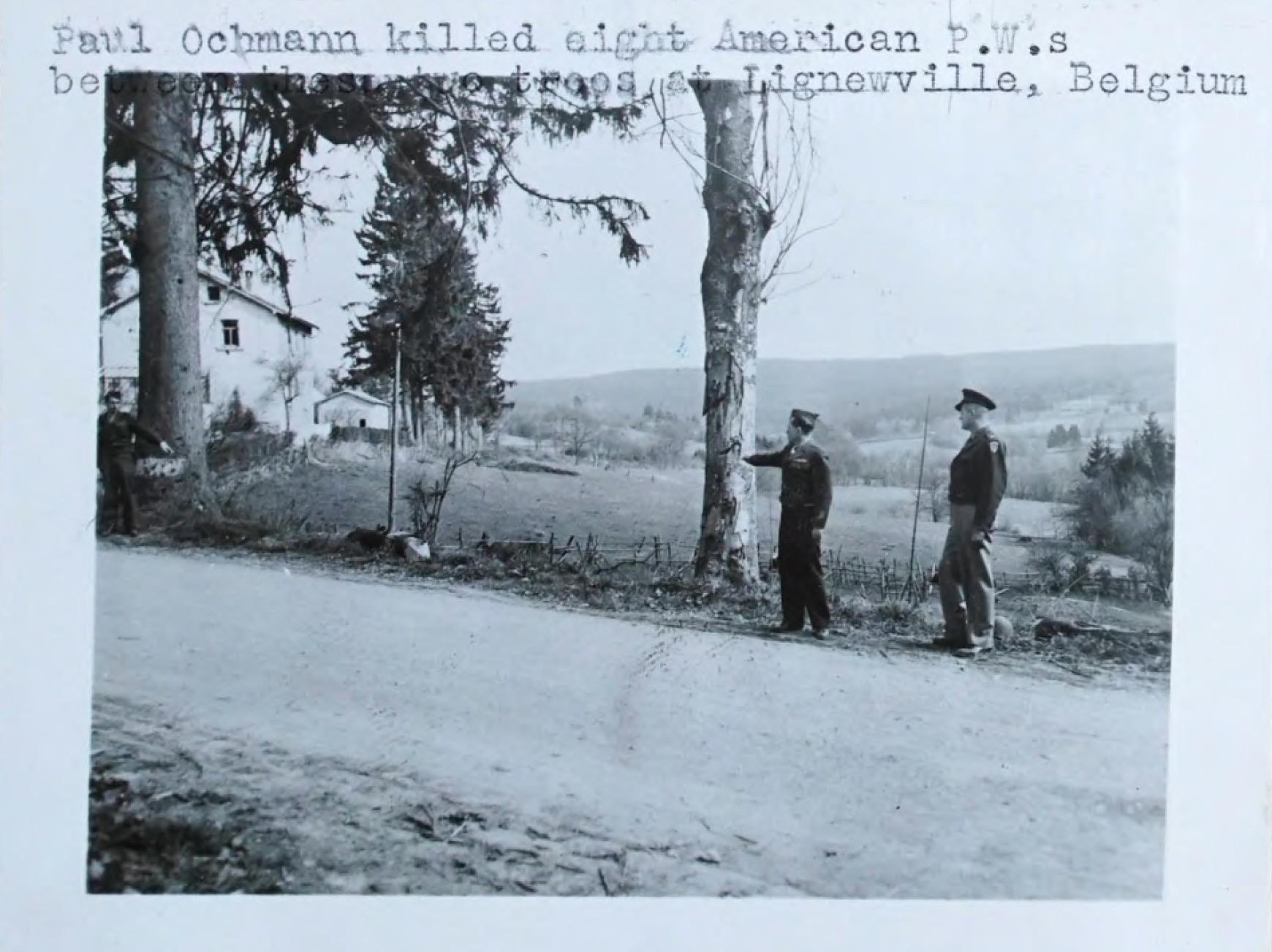
Ligneuville was also the site of one of the lesser-known atrocities of the Peiper march. Nine American prisoners of war were marched north along the road toward Stavelot, where SS-Hauptscharführer Paul Ochmann and an accomplice shot each man in the back of the neck. Eight died. The ninth, Pfc. Joseph P. Mass, survived because the bullet passed through the side of his neck as he jerked in fear.

Ligneuville (Engelsdorf), commune of Malmedy, on the N62 between Malmedy and Saint-Vith. Baugnez crossroads lies 8 km north; Pont and Stavelot to the west. The Amblève divides the village; the bridge is the tactical key.
Aerial Reconnaissance Ligneuville and the upper Amblève valley. NARA, RG 373, Spot F13946, Exposure LSV-1087. Public domain.

Click markers for key positions. The village straddles the Amblève; the bridge (Pont de Ligneuville) is visible at centre. The N62 from Malmedy enters from the upper right. Image rotated so north is up.

17 December 1944: Arrival
Brig. Gen. Timberlake49th AAA Brigade HQ
17 Dec
c. 12:00
Timberlake escapes Warning reaches the 49th AAA Brigade headquarters at the Hôtel du Moulin around noon. Timberlake, commanding 52,000 personnel across eastern Belgium and Luxembourg, evacuates immediately — leaving dessert and coffee still on the table. He travels northwest via the Refat road toward Stavelot, departing only minutes before the German vanguard arrives.
KG Peiper SpitzeSS-Ostuf. Sternebeck, lead Panther
17 Dec
c. 13:00–14:00
Spitze enters Ligneuville Sternebeck’s two Pz. IV and two SPWs descend from the Baugnez direction into the village. Behind them: Fischer’s Panther No. 152, Peiper in Diefenthal’s SPW, the 11. Panzergrenadier-Kompanie. At c. 13:45, Sternebeck halts near the Amblève bridge and sends men forward to check if it is mined. They come under light weapons fire and several drop to the ground. Service elements of CCB, 9th Armored Division are still in the village: 14th Tank Battalion, 16th Field Artillery, and 27th Armored Infantry service companies. (Castor, La route des massacres, 2005)
[DISCREPANCY: Arrival time. Parker: 13:00. Castor: shortly after 13:30. Grégoire: shortly after 14:00. Bovy: 14:20.]
Abandoned Panther in front of Hôtel des Ardennes, Ligneuville
Wartime photograph Fischer’s Panther No. 152 at the Hôtel des Ardennes Three 9th Air Force officers pose with Fischer’s Panther No. 152, knocked out by TankDozer fire on 17 December and still in place in front of the Hôtel des Ardennes. The officer in the centre is Major William B. Abbott, Jr. The turret number 152 is confirmed by a post-war photograph showing the same tank with the number clearly visible (via @WWIIpix). USAAF, public domain. Print via Flickr/abbottphoto.
Panther No. 152 post-war, turret number visible
Post-war photograph Panther No. 152 — turret number visible Fischer’s Panther still in place in front of the Hôtel des Ardennes months after the battle. The turret number 152 is clearly legible. A child sits on the hull; beer barrels are stacked against the hotel. The tank remained here until it was eventually scrapped. Via @WWIIpix.
Hôtel des Ardennes, Ligneuville, modern view
Modern photograph Hôtel des Ardennes — present day The Hôtel des Ardennes as it appears today, viewed from the N62. Fischer’s Panther was knocked out directly in front of this building on 17 December 1944. Google Street View.
Hôtel du Moulin, Ligneuville, modern view
Modern photograph Hôtel du Moulin — present day The Hôtel du Moulin on the N62. On 17 December 1944, General Timberlake’s staff was at lunch here when Kampfgruppe Peiper arrived. Peiper ate the abandoned American food; Mohnke established the 1. SS-Panzer-Division HQ here that evening. The hotel also served as Kampfgruppe Y’s base during the Panzer-Brigade 150 operations, 19–28 December. Google Street View.
17 December: Fischer’s Panther Destroyed
M4A3 TankDozer14th Tank Bn, CCB/9th Armd
Panther No. 152SS-Ustuf. Arndt Fischer
17 Dec
afternoon
Panther knocked out in front of Hôtel des Ardennes Fischer’s Panther No. 152, following Sternebeck’s two Pz. IV and two SPWs, is hit in the rear by an M4A3 TankDozer under repair nearby. The Panther and the SPW behind it catch fire. Fischer’s driver, Rottenführer Wolfgang Simon, is burned to death. Fischer escapes with severe burns to face and hands. The TankDozer is destroyed by an SPW 251/9 of the 11. Panzergrenadier-Kompanie, slightly behind the Spitze. Peiper personally bandages Fischer. (Castor, 2005: “Juste en face de l’hôtel des Ardennes”)
1 KIA (Rttf. Simon)
10. (gep.) Kp.SS-Ostuf. Georg Preuß
17 Dec
American resistance collapses The TankDozer is silenced by an SPW 251/9 with a 7.5cm cannon. Preuß’s 10. (gepanzerte) Kompanie sweeps the remaining American positions. Resistance collapses within approximately ninety minutes. The 49th AAA Brigade headquarters is captured — but Timberlake has escaped.
Execution site at Ligneuville, Belgium
Trial exhibit Ligneuville execution site Original typed caption: “Paul Ochmann killed eight American P.W.s between these two trees at Ligneuville, Belgium.” Two American officers inspect the site. The road descends northward; the Amblève valley is visible in the background. U.S. Senate, Malmedy Massacre Investigation, Vol. 7, Appendices K–P. Public domain.
17 December: The Executions
SS-Hscharf. Paul Ochmann1. SS-Panzer-Regiment
Private soldier (Seuss)Accomplice
17 Dec
c. 16:30
Twenty-two captured; eight separated and murdered Twenty-two Americans from the 27th Armored Infantry Battalion are captured during the fighting. Eight are separated and ordered to dig graves for three Germans killed in the engagement. The task accomplished, the perpetrator shoots each man in the head. Peiper is inside the Hôtel du Moulin when the eight are killed. The execution takes place approximately 500 metres north of the hotel, along the Route de Stavelot (N62), near the village cemetery where the terrain descends on the eastern side of the road.
Primary source. General Lucius D. Clay’s review (25 March 1949): “In a sworn extrajudicial statement, Ochmann admits to having shot four or five unarmed American prisoners of war in the neck with a pistol while a private soldier assigned to assist him shot the remainder.” Walter Fransee (1. Panzergrenadier-Division) corroborated at trial that Ochmann came to his vehicle to ask for help shooting 8 POWs. Two Belgian civilians testified to the killings but could not identify the perpetrators. Clay: “I am convinced of the guilt of Ochmann of the cold-blooded murder of unarmed American prisoners of war without cause.” Death sentence commuted to life imprisonment due to general findings (Simpson report) that interrogation methods may have involved coercion. Ochmann recanted his confession (11 Feb 1948), claiming he was beaten and held in an unheated room on short rations. Fransee also recanted (2 June 1948). (U.S. Senate, Malmedy Massacre Investigation, Pt. 2, GPO 1949, pp. 360–380)
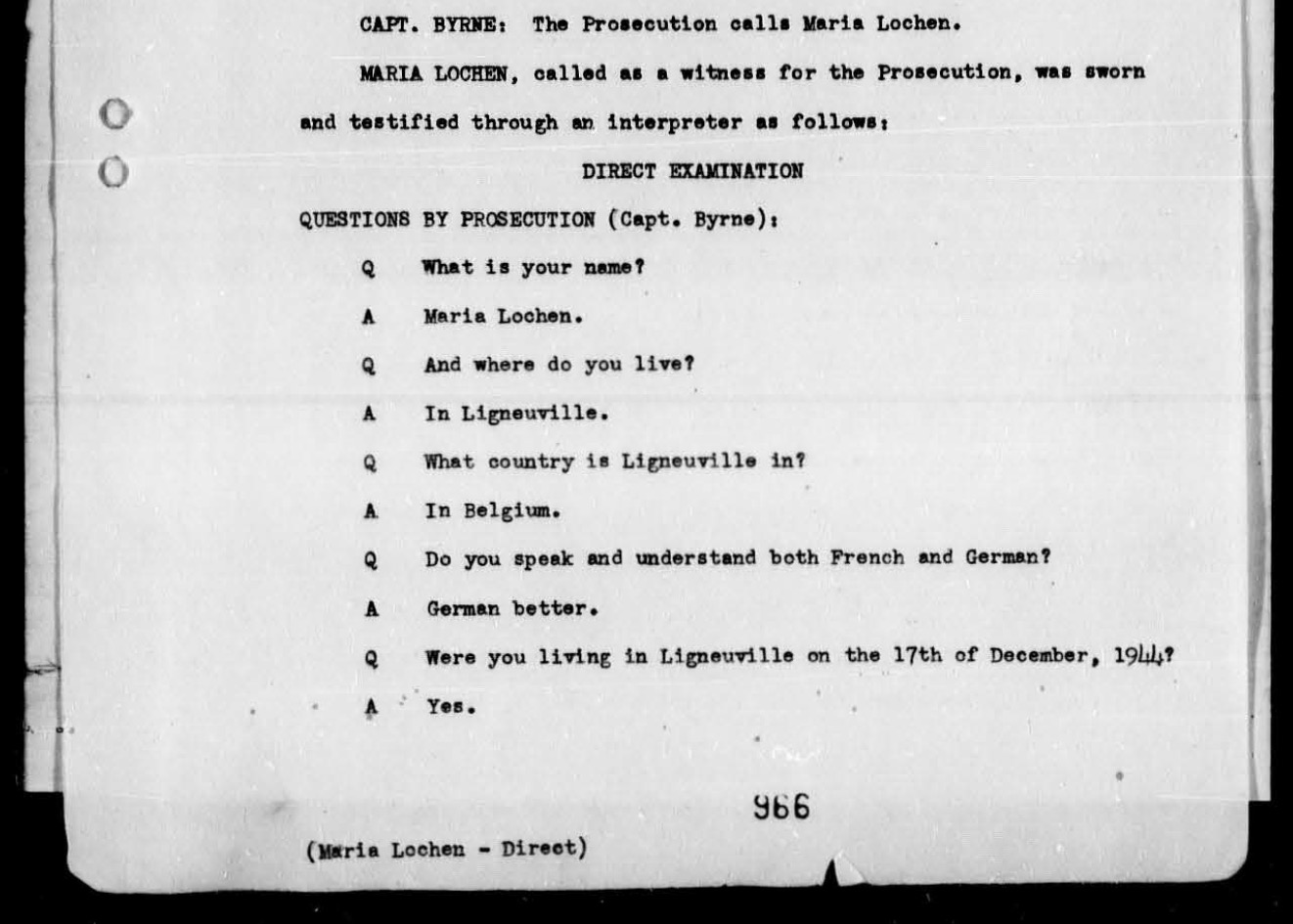
Maria Lochen testimony, p. 966
Primary source. Maria Lochen, sworn testimony (Malmedy Trial Vol. 4, 29 May 1946, p. 966): lived 5–6 metres from the execution site, across from the bakery. Heard shots from her barn; walked out and saw the last three prisoners being shot. Identified perpetrators by Leibstandarte sleeve patch but could not identify individual soldiers. Placed the executions at c. 16:30. Bodies remained in the snow for six weeks before recovery. Trial Exhibits P-76 (photograph of recovery site) and P-77 (sketch with Lochen’s annotations marking her house, the bakery, the Hôtel Rupp, and three body positions).
Secondary source. MacDonald (A Time for Trumpets, 1984): “A Belgian farmer’s wife, Mme. Marie Lochem, who was in her barn tending her cows, looked out to see just over twenty American soldiers marching up the street. A German sergeant, Paul Ochmann, culled eight of them to dig graves for three dead Germans. Once they had finished, Ochmann lined them up in a row. As Madame Lochem watched in horror, the sergeant shot one of the prisoners in the head, then another, and another, until all eight lay prone on the ground.” MacDonald gives seven dead, the eighth (Cpl. Mass) receiving a grazing wound; Mass crawled to trees, received food from a Belgian, attempted to reach Saint-Vith but was recaptured.
[DISCREPANCY: MacDonald vs. trial transcript. MacDonald has Lochen (whom he spells “Lochem”) identifying Ochmann by name and watching him shoot all eight. The actual trial transcript (Vol. 4) shows Lochen could not identify individual soldiers — established under cross-examination by Capt. Harvid. MacDonald appears to have conflated Ochmann’s confession with Lochen’s testimony. MacDonald also gives Mass’s rank as Corporal; Mass’s own sworn statement gives Pfc. MacDonald gives seven dead; the trial record and Clay’s review give eight.]
[DISCREPANCY: Execution location. Lochen’s testimony places the site in the village centre, 5–6 m from her house near the bakery and Hôtel Rupp. A secondary source (citing an “Ammann confession”) places it ~500 m north near the cemetery. These are fundamentally different locations. Lochen’s sworn, cross-examined eyewitness testimony is the stronger evidentiary foundation. Trial Exhibits P-76 and P-77, if found in NARA records, would resolve this definitively.]
8 POWs murdered
Pfc. Joseph P. MassService Co., 27th Armd Inf Bn
17 Dec
evening
The ninth man survives Pfc. Mass, the ninth man in the line, jerks in fear as the pistol is pressed against his neck. The bullet enters one side of his neck and exits the other rather than killing him. He falls and lies motionless with partial right-side paralysis for approximately four hours. After nightfall he crawls into a clump of bushes twenty-five yards from the road. The next morning, a villager finds him, brings a warm drink, and directs him to the hotel. Captain Green recognises him and demands a German doctor. Mass is evacuated with other prisoners on 20 December.
[DISCREPANCY: Vault sources (Castor, MacDonald) give eight men shot, one surviving. Mass’s own sworn statement (20 May 1945) says nine were lined up. Ammann’s confession also implies nine. Eight bodies recovered explains both accounts. Mass never testified at the Malmedy trials; his statement was never entered into evidence.]
17 December: Hôtel du Moulin
SS-Ustuf. KrammRefused execution order
~14 American prisonersMostly 27th Armd Inf Bn
17 Dec
afternoon
Fourteen prisoners survive The remaining fourteen of the twenty-two captured Americans, including Captain Seymour Green, are held in a room on the main floor of the Hôtel du Moulin. They owe their survival to the intervention of the Rupp family, owners of the hotel. Mary Rupp, Peter Rupp’s daughter, tends seven wounded prisoners despite objections from guards. (Castor, 2005; Parker attributes survival also to Kramm’s earlier refusal to carry out Poetschke’s execution order.)
SS-Oberf. Mohnke1. SS-Pz.Div. LSSAH
17 Dec
late afternoon
Mohnke takes Hôtel du Moulin; Peiper moves to Hôtel des Ardennes SS-Oberführer Wilhelm Mohnke arrives and establishes the 1. SS-Panzer-Division forward headquarters at the Hôtel du Moulin, with communications trucks at the rear. Peiper relocates to the Hôtel des Ardennes across the road. The column reorganises and resupplies. Preuß’s 10. Panzergrenadier-Kompanie, delayed at the Thirimont stream, finally rejoins the column. The first Tigers of Major von Westerhagen arrive, though many have broken down en route. (Castor, 2005)
SS-Ostubaf. PeiperKG Peiper CP
Capt. Seymour Green27th Armd Inf Bn (captured)
17 Dec
c. 21:00
Peiper interrogates Green “Good evening, Captain.” Peiper offers a cigarette. “How do you like our tanks?” Green shrugs. “Are you Jewish?” — “No, I am early American stock.” Peiper mocks him as an American Indian (a Karl May reference), grins; Green looks bored. “You’ll go to a good POW camp.” He shows Theodore Dreiser’s An American Tragedy, left on the table by Timberlake: “A perfect title, don’t you think? A chance to understand the enemy.”
Green survived captivity, became an attorney in Ardmore, Pennsylvania, and sent Christmas cards to Ligneuville every year for the rest of his life.
17 December: Night Halt
Peiper & MohnkeEvening council of war
17 Dec
evening
“I now felt the big strike was over” No radio contact since the start line. The rear is chaos: all infantry and artillery trucks bogged between Honsfeld and Ligneuville. Open flanks. No sense that anyone is following. At this point, Kampfgruppe tank losses stand at three Panthers and three Pz. IV destroyed, with eight Panthers and four Pz. IV broken down. Low on fuel, no sleep since 14 December. Peiper: “I now felt for the second time, that the big strike was over.” (Castor, 2005)
KG Peiper SpitzeSS-Ostuf. Karl Kremser, 1st Pz. Kp.
17 Dec
c. 17:00
Column departs; Col. Matthews killed at Pont Around 17:00, the Kampfgruppe resumes its advance toward Stavelot with Kremser’s 1st Panther company in the lead. Just before Pont, Colonel Church Matthews, chief of staff of the 7th Armored Division, on a reconnaissance of the area, runs into the Spitze and is killed. His driver reaches CCB at Recht around 20:45. (Castor, 2005)
Col. Matthews KIA
18 December 1944
KG PeiperToward Stavelot
18 Dec
before dawn
Column departs for Stavelot Peiper’s column resumes the advance toward Stavelot. Kremser’s Panthers had reached the heights above the town the previous evening but halted in the dark. The streets appeared packed with American armour — actually CCB/7th Armored Division supply convoy en route to Saint-Vith, not a defensive force. The overnight halt has cost Peiper his last window of surprise.
Mohnke remains at Ligneuville with the divisional HQ. Green and thirteen other American prisoners are transported east into Germany on 20 December.
Lieux de mémoire

Ligneuville’s memory landscape centres on the Hôtel du Moulin and its owner Peter Rupp, who embodied the dual nature of the village’s wartime experience: a man who sheltered twenty-two Allied airmen during the occupation, watched eight American prisoners murdered outside his front door, and rebuilt his hotel with a memorial to their names.

War Memorial
Memorial to the Murdered US Soldiers
Erected adjacent to the Hôtel du Moulin by Peter Rupp and the townspeople of Ligneuville — not at the execution site 500 metres north, but at the hotel where the prisoners were first assembled. It bears eight names: John M. Borcina, Gerald R. Carter, Joseph Collins, Casper S. Johnson, Abraham Lincoln, Michael B. Penny, Clifford H. Pitts, Nick C. Sulivan. A ninth man, Pfc. Joseph P. Mass, survived.
Adjacent to the Hôtel du Moulin, Grand Rue 28
Historic Building
Hôtel du Moulin
Peter Rupp’s hotel served as Timberlake’s 49th AAA Brigade headquarters, then as Mohnke’s 1. SS-Panzer-Division forward HQ. The dining room where Peiper interrogated Captain Green, the room where fourteen American prisoners were held, and the barn where Peiper slept are all part of the building. Rupp, a secret member of the Belgian White Army under the nom de guerre “Monsieur Kramer,” had sheltered twenty-two Allied airmen during the occupation. He received a certificate from Air Chief Marshal Sir Arthur Tedder honouring his service.
Centre of Ligneuville, on the main road
Battlefield Landmark
Pont de Ligneuville
The bridge over the Amblève where Fischer’s Panther No. 152 was destroyed by the M4A3 TankDozer. The original stone bridge was damaged in the fighting and rebuilt in 1951 as a reinforced concrete arch clad in local sandstone masonry. The blind corner where Fischer drove into the American gun sights is still recognisable. The bridge remains the tactical key to the village: the only crossing point on what was Peiper’s line of march.
Village centre, crossing the Amblève on the N62
Church
Église Foi, Espérance et Charité
Built in 1910 in neo-Romanesque style using local sandstone, the church was damaged during the fighting and restored after the war. Its name — Faith, Hope, and Charity — takes on a particular resonance in a village that experienced both atrocity and acts of individual moral courage within the same afternoon.
Centre of Ligneuville, north bank