Coordinates: 50.4050°N, 5.8450°EElevation: c. 340 mSector: Kampfgruppe PeiperKey dates: 19–24 December 1944German units: Kampfgruppe Peiper (1. SS-Pz.Div. LAH)Allied units: 30th ID (117th, 119th IR), 82nd Abn, 3rd Armd CCB
La Gleize is a hilltop village overlooking the Amblève valley, six kilometres east of Stoumont. In December 1944 it became the final redoubt of Kampfgruppe Peiper: 1,500 men, 15 tanks, and 150 American prisoners penned into a pocket barely a kilometre across, ringed by three American divisions and pounded by over 100 guns.
For three days the SS panzergrenadiers held out among the stone houses and cellars, their Tigers and Panthers hull-down in the narrow streets. Fuel exhausted, ammunition spent, rations unreceived since the offensive began, Peiper requested permission to break out on foot. On Christmas Eve, 800 survivors slipped through American lines in the darkness, wading the flooded Salm River to reach German positions at Wanne. Behind them they left the largest single haul of abandoned German armour in the western front: six King Tigers, thirteen Panthers, and over fifty halftracks.
Today, Tiger 213 — SS-Obersturmführer Dollinger’s King Tiger — stands on the village square outside the December 44 Historical Museum, the only Tiger II in Europe displayed at the location where it actually fought.
La Gleize & environs — key positions during the siege, 19–24 December 1944
La Gleize, commune of Stoumont, Liège province. Stoumont lies 6 km west; Trois-Ponts 4 km south; Cheneux 2.5 km southwest. The N-33 runs through the village toward Stavelot.
Aerial reconnaissance — La Gleize and the Amblève valley. NARA, RG 373, Spot F13946, Exposure LSV-1048. Public domain.
Click markers for positions during the siege. The village of La Gleize sits on the ridge above the Amblève; Wérimont farm commands the N-33 approach from the south-west. North arrow visible top-right of original exposure.
19 December 1944
Kampfgruppe PeiperSS-Ostubaf. Peiper
19 Dec
Day 4
La Gleize as rear basePeiper establishes headquarters at La Gleize while his main forces attack Stoumont to the west and hold Cheneux to the southwest. The village serves as supply depot and command post. But the supply column from Wanne via Recht–Logbiermé fails to get through: Stavelot has been recaptured by the 117th Infantry. Peiper is completely isolated.
20 December 1944
TF Lovelady3rd Armored Division, CCB
20 Dec
Day 5
The N-33 cut: encirclement completeTask Force Lovelady (3rd Armored Division) reaches the La Gleize–Trois-Ponts road, cutting off all reinforcement and resupply. Approximately 40 American tanks advance past La Gleize. Peiper’s fuel and ammunition shortages prevent any counterattack. The trap is closed.
KG PeiperSchenk’s 6th Company
20 Dec
night
Petit-Spai bridge collapsesDuring the night, the bridge at Petit-Spai collapses under the first tracked vehicle attempting to cross. The last armoured route into the pocket is severed. No tank, halftrack, or heavy vehicle can now reach or leave La Gleize.
Last armoured route severed
21 December 1944: Fortress La Gleize
Peiper, Poetschke, Diefenthal, von WesternhagenChâteau de Froidcour gatehouse
21 Dec
noon
Consolidation conferencePeiper assembles his commanders at the Château de Froidcour gatehouse. Holding Stoumont and Cheneux is now senseless. Orders a full withdrawal to La Gleize. The village becomes a fortress: ~1,500 men, tanks hull-down among stone houses, 150mm guns in orchards, SPWs in meadows. ~50 civilians shelter in cellars.
Defensive perimeter15+ tanks, MGs, 150mm guns
21 Dec
afternoon
Fortress dispositionNorth (Montis, Hassoumont): 9th SS Pioneer Company, 4 Panzer IV, 1 Tiger, 1 Panther. Town centre (church, town hall): 5 Panthers. South crossroads: 2 Tigers, 1 Panther. Wérimont farm (controlling N-33 and Roannay valley): Tiger 213 (Dollinger), 2 Panthers, 1 Tiger (Hantusch), 1 Panzer IV (Klingelhöfer), 3 Pumas, 2 Flak.
Maj. H.D. McCown2nd Bn, 119th IR, 30th ID
SS-Ostubaf. PeiperKG Peiper CP
21 Dec
evening
The McCown agreementPeiper summons Major McCown, senior ranking American prisoner, to his command post. ~150 American POWs are held in the church and village cellars. Peiper, speaking perfect English, gives his word they will be treated humanely per the Geneva Convention. McCown knows of the Malmedy massacre and is apprehensive, but Peiper is calm and correct. McCown later testified at Peiper’s trial that the prisoners were generally well treated.
~150 American POWs
22 December 1944: Siege & Failed Relief
TF McGeorge119th IR, 30th ID
22 Dec
morning
American attacks repulsedAmerican artillery intensifies: over 100 guns maintain continuous fire on the pocket. TF McGeorge attacks from the east, losing 4 tanks. 119th Infantry takes the Froide-Cour area. Fierce house-to-house fighting at the village edges, but the Germans restore their perimeter each time. No food has been received since 16 December.
KG HansenCapt. Böttcher, 3rd Bn
22 Dec
dawn
Mohnke’s relief attempt failsCaptain Böttcher leads 3rd Battalion across a footbridge at Petit-Spai, attempting to reach La Gleize. At Biester they encounter Lovelady’s reconnaissance platoon and Stuart tanks. Brutal combat: Lt Gray and his platoon captured, Böttcher wounded, dozens killed. Hansen realises he cannot break through. The relief attempt is over.
Luftwaffe3–20 Junkers 52 (sources vary)
22 Dec
20:00
Aerial resupply: 90% lostGeneral Mohnke dispatches Junkers 52 transports to parachute ammunition, fuel, and food. The defensive perimeter is so reduced that 90% of the packages fall into American positions or no man’s land. Peiper estimates only 10% reaches his men. The fuel recovered is barely enough to keep the radio functioning.
[DISCREPANCY: Castor 2005: 3 aircraft. Pallud 1987: 20 aircraft. Both agree ~90% of supplies fell outside the perimeter.]
Tiger 213SS-Ostuf. Dollinger, Wérimont farm
22 Dec
all day
Artillery destroys key armourAll-day bombardment destroys several German defence pieces, including two Tigers at Wérimont farm that controlled the Amblève valley and the N-33. Tiger 213, Dollinger’s King Tiger, survives — it will later become the museum centrepiece.
23 December 1944: Permission to Break Out
117th & 119th IR30th Infantry Division
23 Dec
all day
Final American assaultsContinuous shelling. 117th and 119th Regiments attack from west and north. Mines, roadblocks, frontal and flanking fire halt each assault with heavy losses. But the German situation is terminal: tanks out of fuel, ammunition expended, rations unreceived for a week. Hansen’s relief has failed. Peiper decides to sabotage all remaining equipment.
SS-Brif. Mohnke1. SS-Pz.Div. LSSAH
SS-Ostubaf. PeiperLa Gleize CP
23 Dec
14:00
Breakout authorisedPeiper receives authorisation from SS-Brigadeführer Mohnke to evacuate La Gleize. Breakout is feasible only on foot, without vehicles or wounded. ~150 American prisoners will be left under Captain Crissinger. German wounded under Dr Dittmann will surrender. McCown will accompany the column as hostage, to be freed when German wounded are repatriated. Assembly: 02:00, Christmas Eve, church square. Password: “Frohe Weihnachten”.
24 December 1944: Christmas Eve Breakout
~800 survivorsKG Peiper, on foot
24 Dec
02:00
The breakout beginsApproximately 800 men, heavily laden with weapons and ammunition, leave La Gleize on foot in single file. Route south along La Coulée path toward La Venne. Two Belgian civilians, Laurent Gazon and Yvan Hakin, requisitioned from a cellar to guide the column to a small wooden bridge below the railway bridge. 150 American prisoners released; 300 German wounded left behind in houses and cellars.
RearguardDemolition teams
24 Dec
c. 05:30
Sky on fireClimbing the hill southward, the column sees the sky ablaze above La Gleize. The rearguard is demolishing tanks, ammunition, and vehicles. Six King Tigers, thirteen Panthers, six Panzer IVs, over fifty halftracks, and dozens of other vehicles are sabotaged or abandoned.
Americans enter La GleizeUnaware the village is deserted, 1st and 3rd Battalions of the 119th Infantry with TF Jordan and Captain Berry’s tanks advance cautiously via the N-33 onto the church square. A few isolated snipers offer weak resistance before withdrawing. 170 American prisoners rush to meet their comrades. 300 German wounded are found in houses and cellars. Americans, aware of the Baugnez massacre, roughly gather captured Germans on the church square and order them to remove boots, trousers, and American equipment.
170 POWs liberated
300 German wounded found
Breakout columnBergeval, night
Co. I, 505th PIRCapt. McPheeters, 82nd Abn
24 Dec
night
Firefight at Bergeval; McCown escapesThe breakout column reaches Bergeval after dark. Farmer Arthur Deroanne is forced to guide them via Fosseheid toward Rochelinval. A firefight erupts with Company I, 505th PIR. Heavy German losses. In the confusion, Major McCown crawls away from the German group, covers 100 metres, and is challenged by an 82nd Airborne outpost. He is home.
25 December 1944: Christmas Day
~770 survivorsKG Peiper, at Wanne
25 Dec
morning
Survivors reach German lines770 survivors of Kampfgruppe Peiper reach Wanne after wading the flooded Salm River in the dark — the tallest soldiers forming a barrier with their bodies against chest-high water to allow smaller men to cross. Peiper is lightly wounded in the hand. Only 30 men were lost en route. 20 kilometres covered in 36 hours. Peiper reports to SS-Oberführer Mohnke at Wanne Castle. Of the ~5,800 men who entered the Ardennes, roughly 800 have returned.
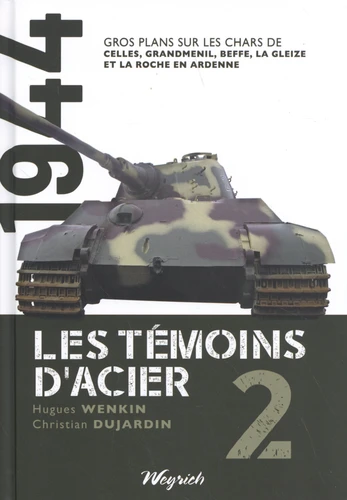
Tiger II number 213 (chassis 280273) belonged to the 1. Zug, 2. Kompanie of the 501. schwere SS-Panzer-Abteilung, an independent heavy tank battalion attached to the 1. SS-Panzer-Division Leibstandarte Adolf Hitler for the Ardennes offensive. The vehicle was manufactured at the Henschel works in approximately October 1944, fitted with the production Henschel turret characterised by a flat frontal plate and broad, rounded gun mantlet. A single Tiger II required approximately 152 days to build. (Wenkin and Dujardin, Les témoins d’acier, 2017, pp. 40–42)
The tank’s original commander was Unterscharführer Franz Faustmann. When SS-Obersturmführer Helmut Wilhelm Dollinger, newly promoted to command the 1. Zug for the offensive, found his own Tiger II immobilised by mechanical failure, he exercised his prerogative as platoon leader and took command of tank 213, displacing Faustmann. (Wenkin and Dujardin 2017, pp. 32–35)
The 501. SS-schwere-Abteilung’s forty-five Tiger IIs were originally held in reserve behind the armoured spearhead. The plan envisaged committing the heavy battalion only after the Meuse crossings, where the open terrain of the Hesbaye plains would allow the 8.8 cm KwK 43 L/71 to exploit its superior range against Allied armour. In practice, the chaos of Peiper’s advance disrupted this entirely: the Tigers inserted themselves individually into the column, guided only by exasperated Feldgendarme whose sole instruction was to follow the vehicle ahead. (Wenkin and Dujardin 2017, pp. 32–35)
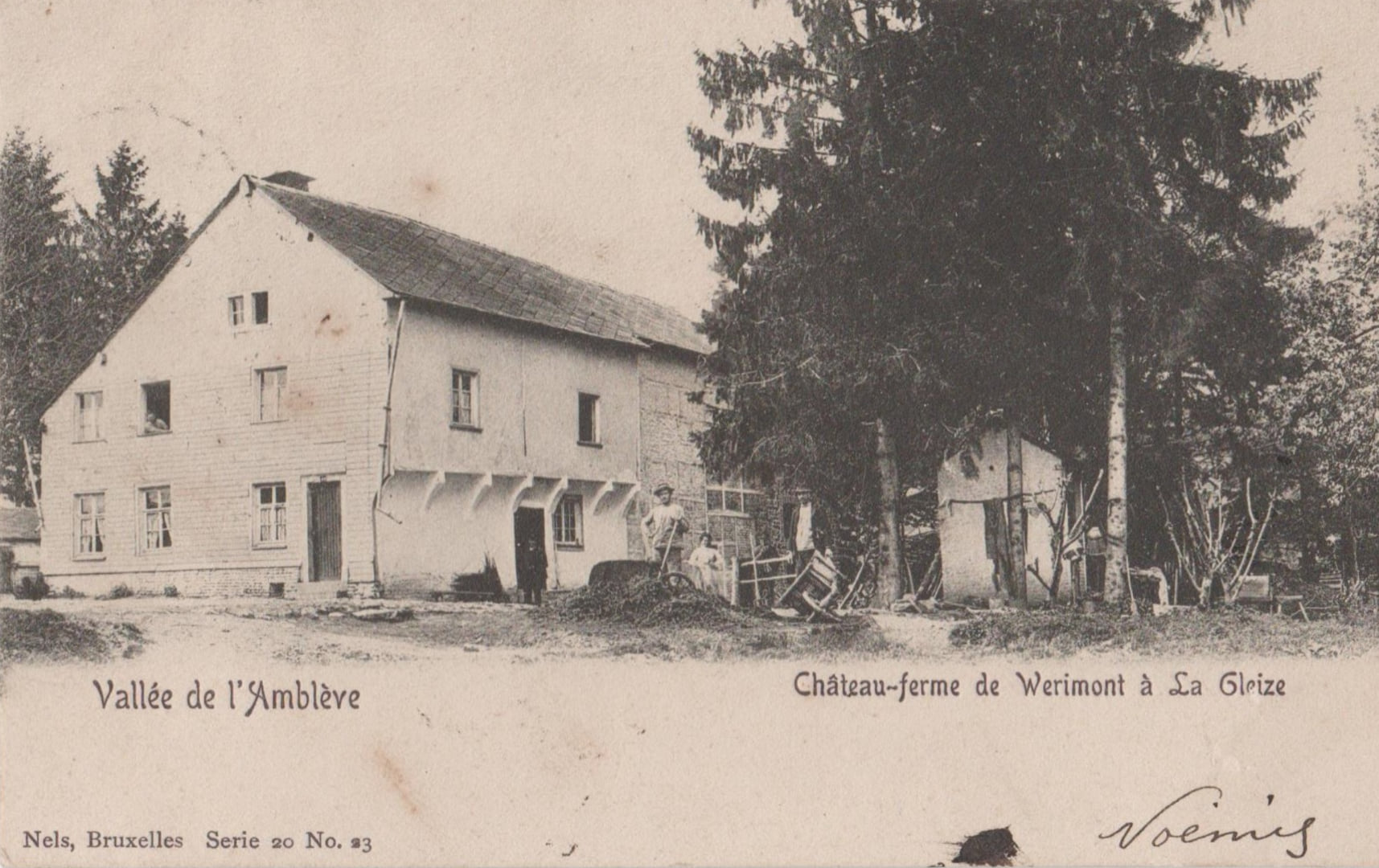
Archival photographChâteau-ferme de Wérimont à La GleizeThe farm where Tiger 213 was positioned during the siege, commanding the N-33 and the Roannay valley approach. Dollinger’s King Tiger engaged American Shermans from this promontory at approximately 1,000 metres.Postcard: Nels, Bruxelles, Serie 20 No. 23 (c. 1900–1910). Via The King of La Gleize. Public domain.
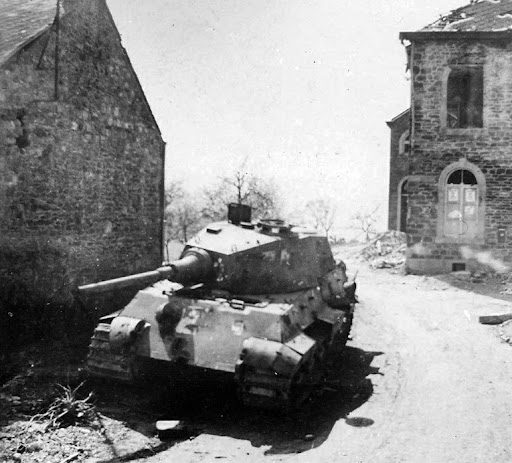
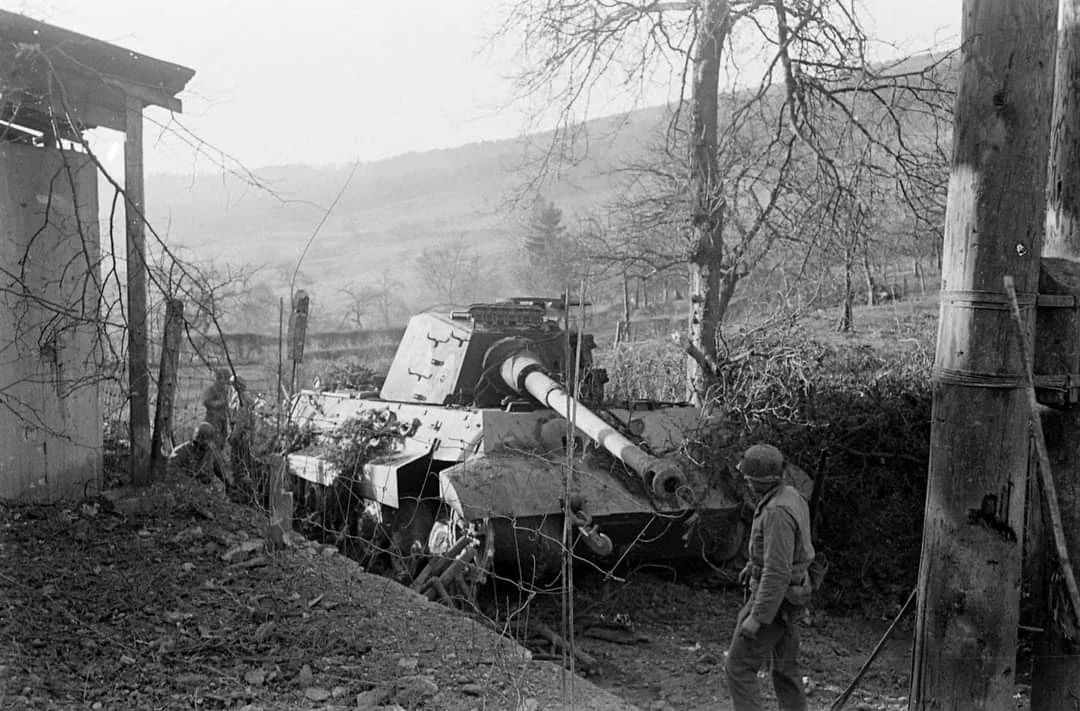
At La Gleize, Tiger 213 was positioned at Wérimont farm, commanding the valley and the Roanne-Coo approach road. When American Shermans advanced down the slope from Roanne-Coo, the 8.8 cm guns of Tiger 213 and Tiger 221, together with Pak 43 anti-tank guns, engaged at approximately 1,000 metres. The Americans returned fire in volume. A direct hit struck Tiger 213’s cannon, rendering it inoperable. Multiple subsequent hits started a fire, knocked out the electrical firing system, and destroyed the optical sights. Dollinger was wounded in the head and evacuated the smoke-filled turret. The crew abandoned the immobilised vehicle. (Wenkin and Dujardin 2017, pp. 36–38; Castor, La route des massacres, 2005, p. 234)
Tactical situation — Wérimont farm engagement, c. 20–22 December 1944
German positions in amber, Allied in blue. Dashed red lines show fields of fire (~1,000 m). Blue arrow shows Sherman approach from Roanne-Coo. Dashed amber polygon shows the defensive perimeter. Click unit boxes for detail.
Post-war preservation — Object provenance
Sources diverge
Castor (2005) and Cuppens (1989) state that innkeeper Mme Jenny Geenen-Dewez persuaded the American recovery crew to leave the tank and later purchased it for a bottle of cognac. Wenkin and Dujardin (2017, pp. 38–40) describe an unnamed woman who physically blocked American personnel preparing to destroy the vehicle, with Mme Geenen subsequently receiving a concession from the commune to keep it in her garden.
The accounts may describe different episodes in a longer sequence of events, but the details are not easily reconciled.
DEC 1944
Abandoned during the Christmas Eve breakout. Cannon destroyed by direct hit, electrical systems burned out, optics shattered. Crew evacuated. Left at Wérimont farm.
1945
American recovery crews prepare to destroy or remove the wreck. A local woman intervenes, preventing its destruction. The tank remains in the village. (Wenkin and Dujardin 2017, pp. 38–40)
1951
Commune attempts to dispose of the tank after repeated vandalism. Bourgmestre Jules Louis intervenes, placing it at a visible public location. (Wenkin and Dujardin 2017)
Syndicat d’initiative, led by Gérard Cuisinier, undertakes restoration. Missing components refabricated, mechanical systems overhauled. (Wenkin and Dujardin 2017)
1986
Volunteers carry out a more thorough restoration. Tank installed at its present location outside the presbytery. (Wenkin and Dujardin 2017, pp. 38–40)
TODAY
Displayed on the village square, Rue de l’Église, outside the December 44 Historical Museum.
Note. The gun currently mounted on the vehicle is not original. The destroyed 8.8 cm barrel was replaced using part of a Panther barrel and muzzle brake, reportedly taken from one of Skorzeny’s disguised tanks, welded onto the surviving section of the original gun. (Castor 2005, p. 234)
Tiger 213 is the only Tiger II in Europe displayed at the location where it actually fought.
La Gleize constitutes one of the densest memoryscapes of the Ardennes Offensive: museum, monumentalisation, preserved armour, and battlefield topography are closely interwoven within a single village. Through the combination of the December 44 Historical Museum, the Tiger II on the square, the 1940–1945 memorial, and the interpretive walking trail, the village offers a paradigmatic example of how small Ardennes communities have transformed combat zones into layered sites of historical pedagogy and transnational remembrance.
Museum
December 44 Historical Museum
Housed in the building that served as Peiper’s actual command post, the museum focuses on the encirclement of Kampfgruppe Peiper, the breakout on the night of 24–25 December 1944, and the material traces left behind. The collection emphasises the local dimension: the experience of La Gleize’s inhabitants under siege, the micro-history of the pocket, and the more than 100 abandoned armoured vehicles recovered from the village and surrounding fields. One of the finest Bulge collections in Belgium.
Centre of La Gleize, Rue de l’Église
Preserved Vehicle
Tiger II “213” (Königstiger)
s.SS-Pz.Abt. 501, turret number 213. Knocked out at Wérimont farm, abandoned during the Christmas Eve breakout, preserved by local intervention. Full account above.
Village square, immediately outside the museum entrance
War Memorial
Monument “Aux 40 millions…”
Standing between the Tiger II and the museum entrance, this monument is dedicated “aux 40 millions d’hommes, de femmes et d’enfants qui perdirent la vie pendant la guerre 1940–1945.” It functions in tandem with the preserved armour and museum to create a single commemorative ensemble — technical artefact, human cost, and historical pedagogy in a few square metres of village square.
Between Tiger 213 and the museum entrance
Interpretive Trail
Memorial Walk around La Gleize (40–45)
A marked walking trail linking La Gleize with neighbouring villages including Cheneux and Monceau. Along the wooded route, multilingual panels (French, English, Dutch, German) present the chronology of the battle in this sector, the suffering of local inhabitants in December 1944, and the final containment and disarmament of Peiper’s troops. The trail follows some of the same paths used by the 504th PIR during their flanking attack on Cheneux and by Peiper’s column during the Christmas Eve breakout.
Starts at the museum; connects to Cheneux, Monceau, and surrounding hamlets
Historic Building
Château de Froidcour
The château served as Peiper’s initial command post and as the holding site for ~130 American prisoners and ~120 German wounded before consolidation at La Gleize on 21 December. It was here that Peiper held his commanders’ conference to order the withdrawal from Stoumont and Cheneux, and where Major McCown was first brought after capture. ~80 German wounded remained at the château under Dr Dittmann when the pocket contracted. Private property; visible from the road.
South of La Gleize, on the road toward Stoumont
Battlefield Landmark
Wérimont Farm
The farm controlled the N-33 road and the Roannay valley — the key southern approach to La Gleize. Three Tigers, two Panthers, a Panzer IV, three Pumas, and two Flak positions were sited here. Tiger 213 stood at this location during the siege. American artillery systematically targeted the farm, destroying two Tigers on 22 December. The farm still stands; the fields where the armour was positioned are visible from the road.
South-west of La Gleize, overlooking the Amblève valley
 Book
Book
 Video
Video